WE ARE NOT A VENN DIAGRAM
Written by Tahirah Yasin
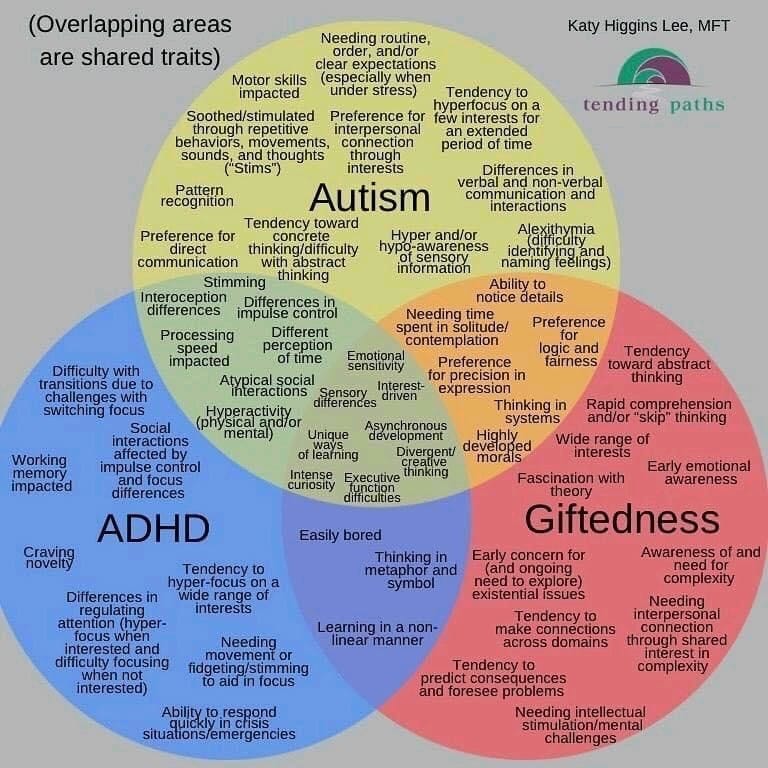
The gifted, the exhausted, the not seen and the world that still hasn’t worked out what to do with us.
Let me say this plainly.
There is a version of the neurodiversity conversation that has become very tidy. Very palatable. It discusses the intersection of race, gender, class, and disability. It stacks the identities neatly on top of each other and says: This person sits at multiple crossroads. It is an important framework. It has given many of us languages we did not previously have.
But it is not enough.
Because a neurodivergent mind is not just a set of social identities. My main argument is that it is rooted in biology a nervous system and a way of processing the world at a cellular level. This cannot be reduced to a list of characteristics, a diagnostic box, or even a diagram of overlapping marginalised experiences.
You are not a Venn diagram. You are a complex, living system. The world—including well-meaning professionals is still learning what that means. Neurodivergent minds are not more complex versions of neurotypical ones. They are differently architected. That difference has costs and gifts that cannot be separated.
THE GIFT THAT BECAME A BURDEN
What nobody tells you about being gifted and neurodivergent. Giftedness, and I use that word carefully, knowing how loaded it is, is not about IQ scores. It is about intensity. It is about a nervous system that takes in more, feels more, processes more, and reacts more than the world expects or accommodates.
Sharon Lind, one of the foremost voices on the social and emotional needs of gifted individuals, describes this as overexcitability, a term drawn from the Polish psychiatrist and psychologist Kazimierz Dabrowski. He identified five forms:
Psychomotor: surplus energy, restlessness, the body that cannot be still
Sensual: heightened experience through all the senses, beauty and overwhelm in equal measure
Intellectual: a mind that cannot stop, that follows ideas down rabbit holes at 2am because it has no off switch
Imaginational: a vivid, elaborate inner world running alongside the external one at all times
Emotional: intensity of feeling, deep empathy, physical responses to emotion, an inner life that is both extraordinary and exhausting
Lind says something quietly radical about these characteristics. She says they are not pathological. They are the constitution. They are as neutral a fact about a person as being left-handed. And then she names what actually hurts: “Highly gifted individuals, because of their uniqueness, can fall prey to the public and personal belief that they are not OK.”
That sentence. That is what I see in clinical practice.
Research into the lived experience of highly gifted young adults confirms what clinicians observe: feelings of not fitting, existential loneliness, perfectionism, and a persistent sense of being “not okay to be me,” even among those who, by most external measures, are thriving (Frumau-van Pinxten et al., 2023). The gifted neurodivergent person does not experience their intensity as a gift most of the time. They experience it as a reason they do not fit. Too much. Too sensitive. Too emotional. Too restless. Too deep. Too relentless. They learn early, efficiently, and with thoroughness to perform a smaller version of themselves so the world stays comfortable. The performance of smallness is not modesty. It is survival. And it has a lifetime cost.
THE EXHAUSTION NOBODY NAMES
When the brain is brilliant, and the body is breaking. There is a specific kind of exhaustion that belongs to the gifted AuDHD person. It has no clinical name. It does not appear in diagnostic criteria. It is rarely the presenting issue in a therapy room. And, in my experience, it is one of the most significant unaddressed forms of suffering in this community. It is the exhaustion of translating constantly, since childhood, between your neurological reality and the world’s expectations of you. Of reading every room. Of calibrating every response. Of being exceptional enough to pass and paying for that passing every single night when the door finally closes.
Damian Milton’s Double Empathy Problem names one dimension of this. He showed, and the research has since supported him, that the communication difficulty between autistic and non-autistic people is not a deficit in the autistic person. It is a
mutual mismatch. But crucially, in a world where non-autistic ways of being are treated as the default, it is the autistic person who does the lion’s share of the cross- neurotype work. The gifted autistic person does it brilliantly. Which means nobody sees that it is work at all.
Resmaa Menakem, a somatic therapist who writes about how trauma lives in the body, not just the mind, gives us language for what happens over time when that work is unacknowledged. He says: When trauma is left constricted, you begin to be
shaped by it. And it is wordless. Time decontextualises it. The body carries what was never allowed to be named.
For the gifted neurodivergent person, this constriction is decades in the making. The nervous system, which was always set too high and never accommodated, learned to override its own signals to keep functioning, and eventually stopped cooperating. The body is not betraying you. It is refusing to continue what never should have been demanded.
WHEN THE BODY SPEAKS, not when the body remembers.
There is a pattern. Gifted, late-diagnosed neurodivergent people are disproportionately women, disproportionately from Global Majority communities, presenting with ME/CFS, lupus, fibromyalgia, and other autoimmune conditions. Bodies that have been pushed beyond what they were built to sustain, for longer than is survivable without consequence. This is not an anecdote. In research called the “Hyper Brain / Hyper Body model”.
The same neurological wiring that produces extraordinary perception produces a nervous system that is always, in some sense, turned up too high. A minor sensory irritant, a sound, a texture, or a social interaction that requires sustained masking can trigger a low-level chronic stress response. Sustained over years, that response alters immune function (Karpinski et al., 2017).
The gifted body, in other words, is not separately unwell. It is the downstream consequence of a gifted mind that was never given permission to rest. The gifted neurodivergent person who develops ME or lupus after decades of masking, performing, translating, shrinking, they are not broken. They are evidence of what it costs to live against your own grain in a world that never made room for you.
And then the cruelty compounds.
Because these are invisible illnesses. Because lupus says, ‘you don’t look sick.’ ME is still contested in medical circles, still met with scepticism, still treated as a psychological weakness rather than a physiological reality. Because the gifted person, who can describe their symptoms with clinical precision, is told, “But you seem so capable.You seem so articulate. You cannot possibly be that ill.” The intelligence that was supposed to be the gift becomes the evidence used against them.
WHAT OUR THINKERS SAY
A constellation of voices on complexity, the body, and what gets missed. Fanon says the problem is not in the person. It is in the system that refuses to see them whole, and in what happens when that refusal is internalised as shame. Menakem says the body carries what the mind could not metabolise. We heal primarily through the body, not just through understanding, and those of us who have never been given permission to stop will carry that in our physiology.
Milton says the work of cross-neurotype translation has always been one-directional. Autistic people have become expert readers of a world that has felt no parallel obligation to understand them. That labour is invisible. It is not free. Dabrowski says what appears to be disorder may be developmental potential in crisis. The breakdown is not evidence of failure. It may be the beginning of something more authentic if it is witnessed rather than pathologised.
Lind says: accept all feelings, regardless of intensity. Overexcitability is not a fault in the person. It is the texture of their reality. And it deserves to be met, not managed. You are not a diagnosis. You are not a category. You are not the sum of your intersecting identities. You are a whole and complex human being whose nervous system was always wired for more, and the world needs to do better by you.
WHAT THIS MEANS FOR SUPPORT
What we need from the people who are supposed to help. If you are a neurodivergent person reading this, especially if you are gifted, late-diagnosed, living with chronic illness, or some combination of all three, you deserve support that does not make you explain yourself from scratch every time. That does not reach for the nearest diagnostic box and miss everything that doesn’t fit inside it. That can hold your intelligence and your struggle in the same breath, without using one to minimise the other.
That kind of support is rare. It should not be.
If you are a practitioner reading this, therapist, coach, GP, physiotherapist, specialist,
or educator, let’s build the community. When a gifted neurodivergent person sits before you and explains their experience
with precision and articulacy, do you find yourself reassured by that precision? Do you think they have good insight, or are they coping? Or do you recognise that the articulacy is the mask that someone who can describe their exhaustion in clinical detail may be the most exhausted person in the room?
Genuine support for this population requires the willingness to look past competence at the cost of competence. To ask not just what is happening, but what it has taken to keep functioning up until this point.
Questions worth asking:
When did you last feel like you didn’t have to perform?
What does your body tell you that your mind keeps overriding?
What have you never believed about?
What would you stop doing tomorrow if you were allowed to?
A FINAL WORD
The neurodiversity movement has given us so much. It has given us language for difference. It has challenged deficit narratives. It has created communities of recognition where people have found themselves, sometimes for the first time.
But we are not done. We have not yet fully named the relationship between giftedness and neurodivergence. We have not yet named the body cost of masking over decades. We have not yet built adequate support for the person who is brilliant
and breaking at the same time. We have not yet fully reckoned with the particular experience of the gifted Global Majority neurodivergent person, carrying all of this in a world that reads their race, their faith, and their neurotype as separate problems to be managed, rather than one integrated person to be known.
That is the work ahead. And it is why Neurodirectory exists not just to connect people to practitioners, but to insist on the complexity that too many systems still refuse to hold.
You are not a Venn diagram. You never were.